
Loading guidelines
WARNING
Always fasten items being carried as securely
as possible using cargo tie-down rings and
fastening materials appropriate for the weight
and size of the load.
In an accident, during hard braking or sudden maneuvers, loose items will be thrown around inside the vehicle. This can cause injury to vehicle occupants unless the items are securely fastened in the vehicle.
To help avoid personal injury during a collision or sudden maneuver, exercise care when transporting cargo. Do not pile luggage or cargo higher than the seat backrests.
Never drive a vehicle with the tailgate open.
Deadly carbon monoxide (CO) gases may enter vehicle interior resulting in unconsciousness and death.
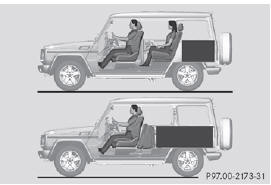
The handling characteristics of a laden vehicle are dependent on the distribution of the load within the vehicle. You should therefore load your vehicle as shown in the illustrations.
The gross vehicle weight (GVW) is the vehicle weight including fuel, vehicle tool kit, spare wheel, installed accessories, vehicle occupants and luggage/cargo.
The gross load limit and the gross vehicle weight rating (GVWR) for your vehicle must never be exceeded. The gross load limit and the GVWR are specified on the vehicle identification plate on the B-pillar of the driver's door .
The load must also be distributed so that the weight on each axle never exceeds the gross axle weight rating (GAWR) for the front and rear axles. The specifications for GVWR and GAWR are on the vehicle identification plate on the B-pillar of the driver's door .
Further information can be found in the "Loading the vehicle" section .
Observe the following notes when
transporting a load:
• position heavy loads as far forwards as
possible and as low down in the cargo
compartment as possible.
Transport loads when possible in the cargo compartment. You should only use the cargo compartment enlargement if the load does not fit in the cargo compartment.
R always place the load against the front or rear seat backrests.
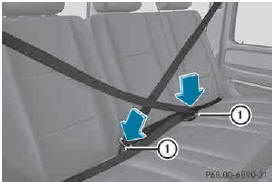
If the rear bench seat is not occupied: ► Insert the belt tongue on the outer seat belts into the buckle of opposite seat belt 1.
► Secure the load with sufficiently strong and wear-resistant tie downs.
► Pad sharp edges for protection.
See also:
Convenience closing feature
Important safety notes
WARNING
When the convenience closing feature is
operating, parts of the body could become
trapped in the closing area of the side window
and the sliding sunroof. There is a ...
First-aid kit
First-aid kit 1 is located in the stowage
compartment in the right-hand door.
Check the expiration date on the first-aid
kit at least once a year. Replace the
contents if necessary, and replac ...
Adaptive brake
ADAPTIVE BRAKE provides increased braking
safety. In addition to the braking function,
ADAPTIVE BRAKE also has the HOLD function and hill start assist
. ...