
Tire tread
WARNING
Insufficient tire tread will reduce tire traction.
The tire is no longer able to dissipate water.
This means that on wet road surfaces, the risk of hydroplaning increases, in particular where speed is not adapted to suit the driving conditions. There is a risk of accident.
If the tire pressure is too high or too low, tires may exhibit different levels of wear at different locations on the tire tread. Thus, you should regularly check the tread depth and the condition of the tread across the entire width of all tires.
Minimum tire tread depth for:
• Summer tires:  in (3 mm)
• M+S tires:  in (4 mm)
For safety reasons, replace the tires before
the legally prescribed limit for the minimum
tire tread depth is reached.
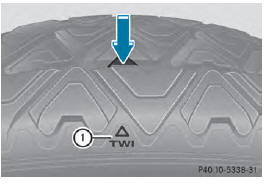
Bar indicator 1 for tread wear is integrated into the tire tread.
Treadwear indicators (TWI) are required by
law. Six indicators are positioned on the tire
tread. They are visible once the tread depth
is approximately  in (1.6 mm). If
this is the
case, the tire is so worn that it must be
replaced.
See also:
Headlamp cleaning system
The headlamps are cleaned automatically if the "Wipe with washer fluid"
function is operated five times while the
lights are on and the engine is running. When
you switch off ...
General notes
Before you first drive off, read this Operator's
Manual carefully and familiarize yourself with
your vehicle.
For your own safety and a longer vehicle life,
follow the instructions and warning n ...
Defrosting the windows
Windows fogged up on the inside
■ Activate the cooling with air
dehumidification function.
■ Activate automatic mode .
■ If the windows continue to fog up,
activate the defros ...