
Parking brake
WARNING
If you must brake the vehicle with the parking
brake, the braking distance is considerably
longer and the wheels could lock. There is an
increased danger of skidding and accidents.
Only use the parking brake to brake the vehicle when the service brake is faulty. Do not apply the parking brake too firmly. If the wheels lock, release the parking brake until the wheels begin turning again.
WARNING
If you leave children unsupervised in the
vehicle, they could set it in motion by, for
example:
• releasing the parking brake
• shifting the automatic transmission out of
the parking position P
• starting the engine.
They could also operate the vehicle's equipment. There is a risk of an accident and injury.
When leaving the vehicle, always take the SmartKey with you and lock the vehicle. Never leave children unsupervised in the vehicle.
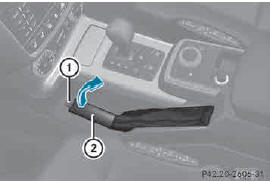
When you apply parking brake ; to brake the vehicle, the brake lamps do not light up.
► To apply: pull parking brake ; up firmly.
Parking brake ; is applied.
When the ignition is switched on or the
engine is running, the  (USA only)
or
 (Canada only) indicator lamp is lit
in
the instrument cluster.
► To release: depress the brake pedal and keep it depressed.
The selector lever lock is released.
► Pull parking brake ; up firmly.
► Press release button : on parking brake ; and move parking brake ; down to the stop.
When the ignition is switched on or the
engine is running, the (USA only)
or  (Canada only) indicator lamp
goes
out in the instrument cluster.
If you pull away with parking brake ; applied, a warning tone sounds.
See also:
Driving tips
General driving tips
Important safety notes
WARNING
Always remember that you must concentrate
primarily on driving the vehicle. The driver's
concentration must always be directed
primarily at r ...
Operator's Manual
Notes on the Operator's Manual
This Operator's Manual contains a great deal
of helpful information. We urge you to read it
carefully and familiarize yourself with the
vehicle before driving.
For ...
Instruction labels for tires and loads
WARNING
Overloaded tires can overheat, causing a
blowout. Overloaded tires can also impair the
steering and driving characteristics and lead
to brake failure. There is a risk of accident.
Obser ...