
Driving on wet roads
Do not drive through flooded areas.
Check the depth of any water before driving through it. Drive slowly through standing water. Otherwise, water may enter the vehicle interior or the engine compartment.
This can damage the electronic components in the engine or the automatic transmission. Water can also be drawn in by the engine's air suction nozzles and this can cause engine damage.
If you have to drive on stretches of road on
which water has collected, please bear in
mind that:
• the maximum permissible fording depth in
still water is 24 in (60 cm)
• you should drive no faster than at walking
pace.
Off-road fording
The water depth may not exceed a maximum of 24 in (60 cm). Note that the possible fording depth is less in flowing water.
Under no circumstances should you accelerate before entering the water. The bow wave could cause water to enter and damage the engine and other assemblies.
Do not open any of the vehicle's doors while fording. Otherwise, water could get into the vehicle interior and damage the vehicle's electronics and interior equipment.
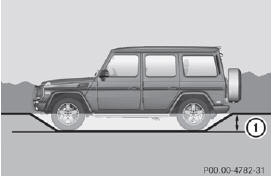
1 Fording depth: 24 in (60 cm)
The fording depth must not exceed 24 in (60 cm) when the vehicle is loaded and ready to drive.
You may only drive through fresh water.
R Observe the safety notes and the general notes on off-road driving.
• Establish how deep the water is and the characteristics of the body of water before fording.
• Switch off the air-conditioning system.
• Shift the transfer case to LOW RANGE.
• Engage the differential locks, if necessary .
• Restrict the shift range to 1 or 2.
• Avoid high engine speeds.
• Enter and exit the water at a flat place and at a steady walking pace.
• Drive slowly and at an even speed through the water.
• Do not stop and do not switch off the engine.
• Water offers a high degree of resistance, and the ground is slippery and in some cases unstable. Therefore, it is difficult and dangerous to pull away in the water.
• Ensure that a bow wave does not form as you drive.
• Clean any mud from the tire tread after fording.
• Apply the brakes to dry them after fording.
• Water offers a high degree of resistance, and the ground is slippery and in some cases unstable. Therefore, it is difficult and dangerous to pull away in the water.
• Ensure that a bow wave does not form as you drive.
• Clean any mud from the tire tread after fording.
• Apply the brakes to dry them after fording.
See also:
Occupant safety
Overview of occupant safety
In this section, you will learn the most
important facts about the restraint system
components of the vehicle.
The restraint system consists of:
- seat belts
- child ...
Cockpit
...
Adaptive brake
ADAPTIVE BRAKE provides increased braking
safety. In addition to the braking function,
ADAPTIVE BRAKE also has the HOLD function and hill start assist
. ...